

Responding to climate change
- Views on climate change
- Improving resilience
- Approaches to preventing global warming
- Total energy consumption and carbon dioxide emissions related to our domestic operations
- Management of fluorocarbons
- Utilization of natural refrigerants
- Promoting eco-driving
- Introduction of low-emission and fuel-efficient vehicles
- Energy-saving activities in offices, warehouses, etc.
- Switching to LED lighting
- Solar power generation and electricity sales business
- Contributing to CO₂ reduction through 3PL business

Views on climate change
Recognizing that protecting the global environment is a crucial issue for all of humanity, our company strives to harmonize business activities with environmental conservation and reduces environmental impact through environmentally conscious business practices. We endorse the recommendations compiled by the Task Force on Climate-related Financial Disclosures (TCFD), established by the Financial Stability Board (FSB) in 2015, and we analyze and evaluate the risks that climate change poses to financial markets, disclosing information in accordance with the "governance," "risk management," "strategy," and "metrics and targets" recommended by the TCFD.
Improving resilience (adaptation to climate change)
At our company, in response to increasingly severe natural disasters, especially typhoons, we coordinate countermeasures between our branches on a regular basis, updating them as needed, and striving to prevent or reduce damage.
Specifically, we are coordinating on matters such as cargo storage and securing methods, and ensuring employee safety when performing tasks that differ from the usual procedures.
For example, at branches located in the path of natural disasters (especially typhoons), countermeasures are taken based on knowledge gained from past experience, such as protecting shutters, securing cargo handling equipment, and securing containers, to prevent damage to facilities from strong winds.
Furthermore, the Risk Management Department is working on introducing an employee safety confirmation system and a system that allows for centralized confirmation of disaster prediction information issued by the Ministry of Land, Infrastructure, Transport and Tourism and local governments in the vicinity of each branch office.
-
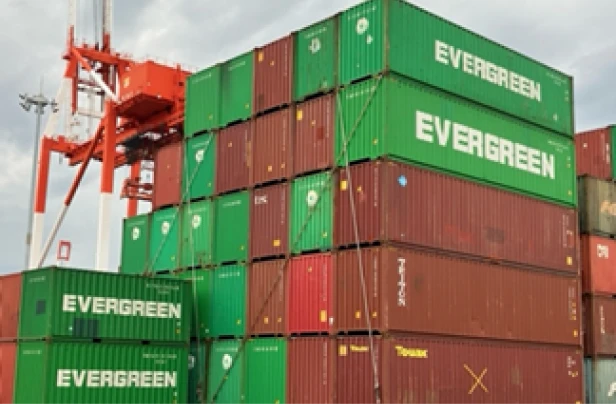
Container securing
-
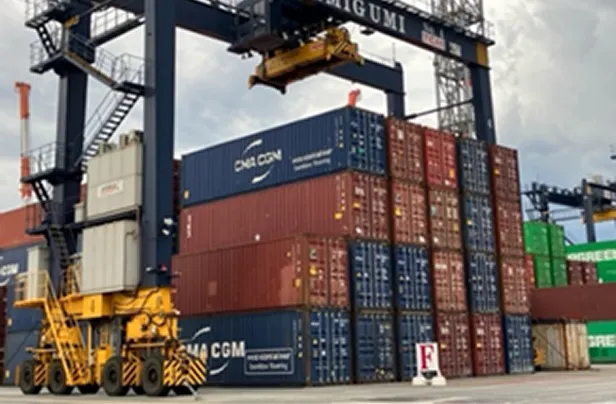
Securing cargo handling equipment
-
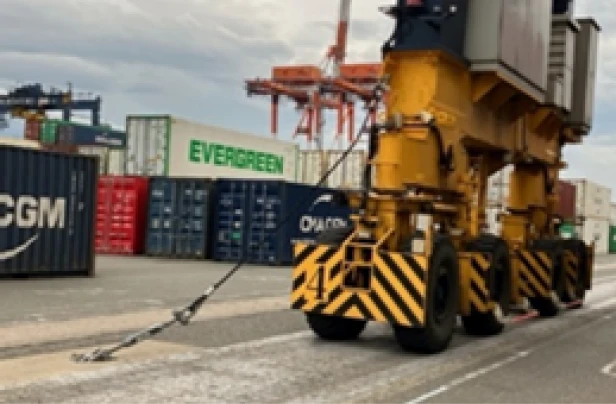
Enlarge the image on the left.
Approaches to preventing global warming
As one of our material issues, we have identified our contribution to carbon neutrality and will actively work to curb and reduce CO₂ emissions. Furthermore, as one measure to promote CO₂ reduction, we will also actively work to improve, reduce, and control the efficiency of our energy use.
Total energy consumption and carbon dioxide (CO₂) emissions related to our domestic operations
Our company is committed to reducing CO₂ emissions through the efficient use of energy in our domestic business activities. By switching various facilities to energy-efficient equipment, we are promoting a reduction in energy consumption, while simultaneously aiming to reduce Scope 1 and 2 CO₂ emissions compared to 2013 levels as follows.
- Target year: 23% reduction by fiscal year 2026
- Target year: 46% reduction by fiscal year 2030.
-
Our total CO₂ emissions

2022 2023 FY2024 Scope1 31,356.45 32,076.58 31,655.96 Scope2 55,138.00 65,076.00 61,452.00 subtotal 86,494.45 97,152.58 93,107.96 Scope3 - 679,847.97 760,623.00 total 86,494.45 777,000.55 853,730.96 -
Total energy consumption by our company
(Scope 1 and Scope 2 only)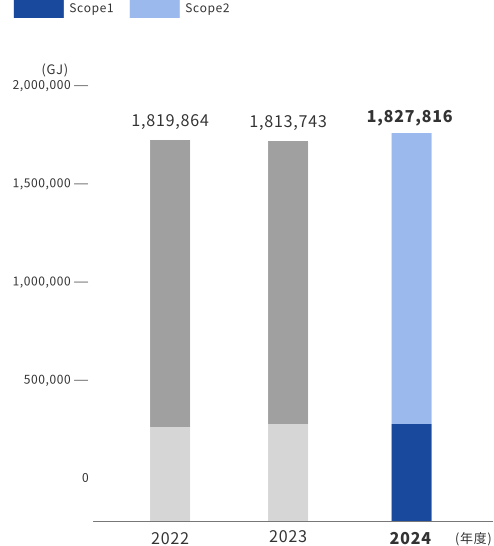
2022 2023 FY2024 Scope1 457,807 463,704 459,208 Scope2 1,362,057 1,350,038 1,368,608 subtotal 1,819,864 1,813,743 1,827,816
Actual values related to climate change
Breakdown of Scope 3 CO₂ Emissions (FY2024)
| Emissions (t-CO₂e) | |||
|---|---|---|---|
| Category 1: Purchased Products and Services | 680,142.00 | Category 9: Transportation and Delivery (Downstream) | Not applicable |
| Category 2: Capital Goods | 57,952.00 | Category 10: Processing of sold products | Not applicable |
| Category 3: Fuel and Energy Related | 9,695.00 | Category 11: Use of sold products | Not applicable |
| Category 4: Transportation and Delivery (Upstream) | - | Category 12: Disposal of sold products | - |
| Category 5: Waste | 3,057.00 | Category 13: Leased Assets (Downstream) | 7,140.00 |
| Category 6: Business Trip | 607.00 | Category 14: Franchise | Not applicable |
| Category 7: Employees' Commuting | 2,030.00 | Category 15: Investment | Not applicable |
| Category 8: Leased Assets (Upstream) | Not applicable | Scope 3 Total | 760,623.00 |
*Emission intensity is calculated using the following: Ministry of the Environment "Emission Intensity Database for Calculating Greenhouse Gas Emissions, etc., of Organizations Through Supply Chains [Ver. 3.4]"
IDEA [Ver.2.3]
*Calculations are based on domestic Japanese business operations.
Calculation based on the GHG protocol
*Category 1 is calculated by assigning 26 types of departmental purchase items from the 2024 payment database.
Breakdown of Scope 3 (%)

*Categories 4 and 12 are currently uncalculated due to the difficulty in collecting data.
*Category 8 includes vehicle leases, but fuel is accounted for under Scope 1.
*Category 9 does not involve the sale of products, therefore no shipping or delivery is required.
*Category 10 does not involve the sale of products, therefore no processing is required.
*Category 11 does not involve the sale of products, therefore no waste is generated during use.
Management of fluorocarbons
At our company, we store cargo that requires low-temperature management using refrigeration and freezing equipment.
Since fluorocarbon gases are used as refrigerants in refrigeration and freezing equipment, we comply with the maintenance and periodic inspections of the equipment as stipulated in the "Fluorocarbon Emission Control Law," and we submit annual reports on these activities and leakage amounts to the relevant ministries and agencies.
As part of our efforts to reduce environmental impact and manage CFCs, we are working together to replace all refrigeration equipment in our main cold storage warehouses with energy-efficient natural refrigerant models. Our medium- to long-term transformation goals, set towards realizing a sustainable society, are as follows:
| Conversion targets including equipment and machinery | 2030 | 2040 | The total number of major refrigeration equipment units in our company, including existing equipment. |
| Main freezer equipment | 10 | 14 | 36 |
| Main refrigeration equipment (%) | 28 | 39 | - |
*Main warehouses are those that operate at an internal temperature of -18°C or lower, as defined by our company.
Other temperature-controlled warehouses are generally temperature-controlled warehouses and are considered separate from the main warehouse in this case.
Our company promotes eco-driving. Eco-driving promotion officers are appointed at all domestic branches to educate and instruct employees on eco-driving practices while driving vehicles, and they also manage and supervise this practice using tachographs.
As part of our efforts to combat global warming, we actively purchase low-emission and fuel-efficient vehicles that have a low environmental impact.
-
Our company implements the "Cool Biz" and "Warm Biz" initiatives recommended by the Ministry of the Environment. During the summer months (May to September), we set the air conditioning temperature in our offices to 28 degrees Celsius, and during the winter months (November to March), we set the heating temperature to approximately 20 degrees Celsius.
In addition, we are reducing the amount of lighting that does not interfere with work, and turning off lights in unused rooms and during lunch breaks. -
Electricity usage

To conserve energy and reduce CO₂ emissions, we are gradually switching the lighting in our offices and warehouses to LEDs.
-
Our company owns solar power generation facilities (capacity: 2.95MkW) on the rooftops of our warehouses and on our owned land, and our power generation in fiscal year 2024 was approximately 33 million kWh.
-
Amount of electricity generated by solar power

Typically, cargo unloaded from a ship is transported inland after customs clearance, stored in warehouses, and then delivered to designated locations in the required quantities according to orders from shippers.
At the designated location, the consignor performs tasks such as quantity adjustments and packaging, and the goods are then transported to mass retailers and ready for consumer purchase.
On the other hand, our company can handle all of these processes in one go. We can clear customs and store the cargo unloaded from the ship in an adjacent warehouse, adjust quantities and pack it, and then ship it directly to retailers according to the shipper's order. This eliminates transportation and indirect work, and consequently reduces CO₂ emissions.